Download the Fact Sheet
Fact Sheet and How
To Contribute
Global Alliance against
Hunger and Poverty
THE CHALLENGE
Despite progress, hunger and poverty remain persistent global challenges that undermine development and stability, with relevant repercussions in climate change, public health, and intergenerational inequality. Implementation of Sustainable Development Goals 1 (poverty eradication) and 2 (zero hunger) is slowing down or backtracking. Social protection policies are absent or insufficient in most low-income countries. Current financing mechanisms often suffer from fragmentation, small-scale focus, high transaction costs, and risk aversion, limiting their effectiveness.
THE GLOBAL ALLIANCE
Existing efforts seem insufficient to bring the world back on the path to zero hunger and poverty eradication. Unprecedented global challenges call for greater and more effective commitment, financing, and action at all levels. The Global Alliance Against Hunger and Poverty (“Alliance”, in short) represents an innovative approach to tackling these issues.
The Alliance aims to (a) provide sustained political drive and galvanize collective action, building synergies with other existing efforts to combat hunger and poverty; and (b) facilitate mobilization and improved alignment of domestic and international support, including public and private financial resources and knowledge, to enable large-scale country- owned and country-led implementation of evidence-based programs and policy instruments, focusing on countries most affected by hunger and extreme poverty and persons in vulnerable situations.
UNANIMOUS ENDORSEMENT
The Ministerial Meeting of the G20 Task Force for the Establishment of a Global Alliance Against Hunger and Poverty took place on July 24 in Rio de Janeiro, with the participation of the President of the Republic. On the occasion, the creation of the Alliance and its institutional structure was unanimously endorsed through the approval of four documents:
- Foundational Document “United Against Hunger and Poverty”;
- Template for the Individual Declaration of Commitment to the Alliance;
- Terms of Reference and Governance Framework; and
- Criteria for the Reference Policy Basket.
Innovative approach
REDUCED TRANSACTION COSTS
The Alliance acts as a neutral matchmaker for building policy implementation partnerships, leveraging a unified database for countries and donors, streamlining the identification of knowledge and funding needs and opportunities. This reduces the time and resources required to identify and engage appropriate partners.
RISK MITIGATION
A “Policy Basket” of rigorously evaluated public policies ensures that donor investments are directed to cost effective, high-impact initiatives. The involvement of a prestigious Board of Champions further builds trust and reduces perceived risk.
ECONOMIES OF SCALE AND SCOPE
By favoring the pooling of resources and expertise, the Alliance enables greater impact and efficiency than individual and fragmented efforts. This allows for the implementation of comprehensive, multisectoral strategies that address hunger and poverty, while paving the way for overcoming intergenerational inequalities.
FLEXIBILITY AND COLLABORATION
The Alliance facilitates straight donor-to-recipient funding, but also enables domestic mobilization and diverse funding modalities, including co-financing and blended finance, attracting a wider range of donors and tailoring solutions to specific needs.
POLITICAL MOMENTUM
Underpinning all of the above, the Alliance will also provide political momentum by promoting and leveraging high level events at the G20 and the UN, offering regular opportunities for participating countries and organizations to renew and reinforce their commitments and ambition, and take stock of progress made.
How will the Alliance work in
practice: Two basic steps
STEP 1—PREPARATION
Building the infrastructure. The Alliance will consolidate four sets of information and commitments into a unified registry: (a) Effective
evidence-based policies for SDGs 1 and 2 (the Policy Basket); (b) Member entities, both state and non-state, willing to fund SDGs 1 and 2 policies (not projects nor broad national strategies); (c) Institutions, both state and non-state, interested in technically supporting the development, implementation, or monitoring of public policies based on the Policy Basket; (d) Member’s priority programs and areas of interest, whether in the role of cooperation demanders or providers. All commitments and information will be submitted voluntarily, including details on the amount and types of funding and knowledge members are prepared to contribute to the Alliance.
STEP 2—MATCHMAKING
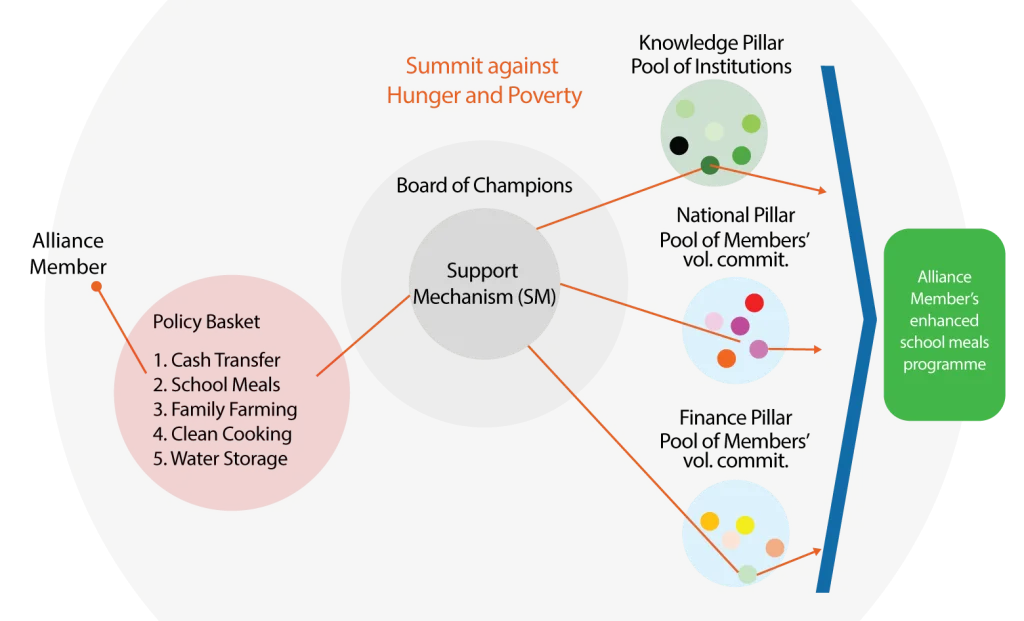
The Alliance, with its unified registry, will be open to member countries’ requests for assistance. Members will specify the Policy Basket policies for which they request implementation support in order to advance SDGs 1 and 2. Requests can be directed to the Alliance’s support mechanism or a partner UN country bureau. Alliance staff will then look for and interface with potential partners and present options to the requesting country. If agreed upon, the Alliance will facilitate negotiations. If difficulties arise, the Board of Champions, composed of senior representatives from countries and international organizations providing financial and/or knowledge support, may intervene. The Alliance aims to be an impartial mediator, fostering cooperation among members to combat hunger and poverty, with initiatives originating from member countries, in a country-led, demand-driven process (see page 16—“Examples of Impact” for a simplified visual schematic of the process).
The Global Alliance Policy Basket
The Policy Basket is the core of the Global Alliance. It aims to provide a menu of policy instruments that can be adapted to a particular national or subnational context with the support of willing Alliance members from the Financial Support and Knowledge Pillars.
The inclusion of a policy instrument in the Basket enables the Alliance Support Mechanism and Board of Champions to look for partners to support the implementation of that instrument upon the request of a member country.
The instruments in the Basket are translated into two templates containing:
- A general policy instrument with a brief description of main features; and
- Country examples to highlight variations in design, implementation, and impacts.
Becoming a Member
Of The Glocal Alliance
The Global Alliance against Hunger and Poverty can be joined voluntarily through the issuance of tailored Statements of Commitment by any of these entities in communication with the Alliance through the Support Mechanism (or with the Brazilian G20 Presidency until its implementation):
- UN Member and Observer States and G20 members;
- United Nations and its associated bodies, programs, and specialized agencies;
- Other regional and international intergovernmental organizations;
- National, regional and international aid and development agencies;
- National, regional and international development banks;
- International funds, and other trust funds;
- Local, national, regional and international think tanks, research centres, academia and other knowledge organizations;
- Philanthropic organizations;
- International platforms, mechanisms, networks, initiatives, collectives, and civil society organizations.
Membership in the Alliance implies a number of commitments by the joining entity, which is expected to exert its best efforts to deliver on them. Alliance members, depending on their situation, may receive support from other members for the implementation of the policies and programs they committed to under the Alliance. In the case of non-governmental entities, membership will be subject to approval by consensus by the Alliance’s Board of Champions in case specific concerns are raised by Global Alliance member States.
How to join the Global Alliance
before November 2024 as a
founding entity —step by step guide
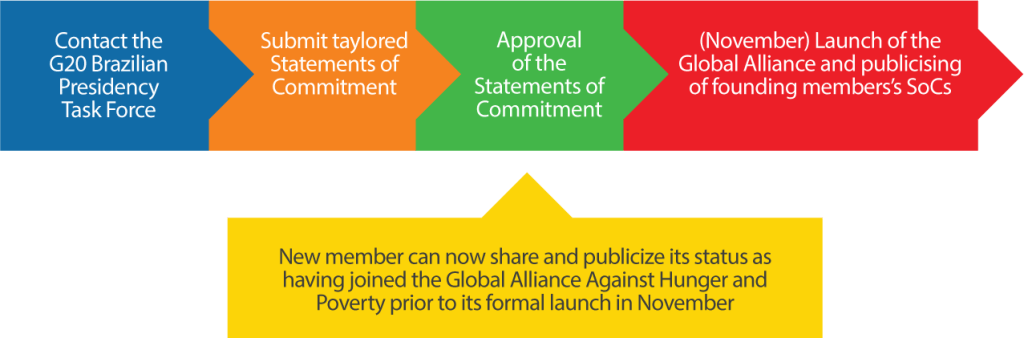
Previous to the formal launch of the Alliance in November, and prior to the establishment of the Global Alliance Support Mechanism, potential members wishing to join the Global Alliance (if they fit the list of entities in the previous section) can contact the following entry points:
- The G20 Brazilian Presidency Task Force Team directly through [email protected];
- The Brazilian embassy in their country;
- The Brazilian representation in their institution, in case of UN Agencies and other international organisations when applicable.
After contacting the Brazilian G20 Presidency directly or through a Brazilian representation, potential members must craft and submit their own tailored Statements of Commitment based on the provided template.
The G20 Task Force presidency team will be available to assist with any doubts during the process, ensuring that the contents are adequately aligned with the core themes and objectives of the Alliance, while keeping the mandatory sections intact.
Once an agreement is reached on a suitable version of the Statement of Commitment (SoC), the G20 Presidency will formally notify the entity via email. At this point, the potential member party will be able to disclose and publicize its role as a future Global Alliance Member.
Countries that submit their SoC will have the option to produce a short video message, which will be shown to the G20 Leaders during the Global Alliance’s launch at the G20 Leaders’ Summit in November. Additionally, all SoCs will be published on the Global Alliance’s website, alongside a list of its founding members, at the launch around the Leaders’ Summit in November.
The Statements of Commitment are inherently flexible documents. Members can choose to update their Statements with further and more precise commitments at any time after their publication and the launch of the Alliance, although the key basic commitments cannot be withdrawn without the entity also leaving the Alliance.
An editable template for the Statements of Commitment, along with specific instructions, is available on the Global Alliance’s page at the G20 website, alongside foundational documents, special reports, and other relevant materials. Brazil’s own Statements of Commitment can serve as a good reference point for inspiration.
Frequently asked questions
How is the Alliance different from existing initiatives? Unlike many current development assistance models, the Alliance focuses on supporting national public policies. In addition, the Alliance’s emphasis on evidence-based solutions, programme-level implementation, and the creation of synergies and coordination among development partners can foster greater donor confidence, leading to increased and more efficient resource allocation.
Is the Alliance a G20 exclusive initiative? No. Under the Brazilian G20 presidency, the G20 provided a platform to put together the initial framework of the Alliance and create momentum for its launch. Following its launch at the November G20 Ministerial Summit, the Alliance will operate independently as a standalone platform, although it will keep a reporting and feedback link to the G20.
Is the Alliance an UN body? No. It is an autonomous initiative leveraging UN bodies and other organizations for its operations, without having itself a legal personality. The Alliance is conceived as a country-driven initiative.
Who can join the Global Alliance, and how is that done? The Global Alliance against Hunger and Poverty can be joined voluntarily through the issuance of tailored Statements of Commitment by countries, international organizations, development banks, philanthropies, and knowledge organizations, among others, in communication with the Alliance through the Support Mechanism (or with the Brazilian G20 Presidency prior to the Support Mechanism’s implementation). More details can be found in the Alliance’s Terms of Reference and Governance Framework, and a step-by-step guide can also be downloaded on this page: https://www.g20.org/en/tracks/sherpa-track/hunger-and-poverty
How can I support the Alliance besides formally joining it? Not every entity is suited to become a formal member under one of the Alliance’s three pillars. But there are many other ways to collaborate, support the Alliance, and join in its work. Advocacy, awareness raising, organizing local events, and others can be done by interested CSOs and NGOs with related mandates. Those entities and local civil society, private sector, and stakeholders can also join in consultations or in the actual implementation of country-owned, country-led policies and programmes supported by the Alliance, including through public-private partnerships.
What are the Alliance’s constitutive documents? At its ministerial meeting on 24 July 2024, the dedicated G20 Task Force endorsed a political document (Inception Document) to enable the creation of the Alliance. This political document is accompanied by three other constitutive documents crafted by the Task Force: Criteria for the Reference Policy Basket; Terms of Reference and Governance Framework; and templates for the Statements of Commitment. The Alliance’s governing bodies, including the Board of Champions, will establish more detailed rules and procedures as necessary. The set of constitutive documents can be found here: https://www.g20.org/en/tracks/sherpa-track/hunger-and-poverty
How much will the Alliance cost? The Support Mechanism (staff) will cost USD 2-3 million/year and will operate from launch until 2030. It will operate in a distributed manner, leveraging partnerships and secondments from partner countries and organizations, including a presence at a global South capital (possibly Brasilia) and at FAO’s headquarters in Rome. The Board of Champions are senior representatives of their respective countries/entities, which will bear the costs of their respective representative’s participation. Summit costs will be borne by the convening country.
Does the Alliance need an exclusive fund? No. It is not supposed to be or to manage an exclusive Fund. Within the scope of its mission, the Alliance’s financial tasks are (a) facilitating funds (as listed in the registry) towards promising SDG 1 and 2 public policies, and (b) motivating donors to make funds available, on a voluntary basis, for potential matchmaking. Additional innovative options to coordinate, synergize, and/or pool resources from multiple sources in benefit of a better, bigger, and more effective delivery at the country level could also be explored among willing partners.
Examples of impact
- Consider a scenario in which a middle-income country opts to implement a conditional cash transfer program but requires assistance in establishing a citizen database. Through the Alliance, the member country can access proven best practices from other members and identify potential partners willing to assist in the development of its own national model.
- Consider a scenario where a country’s school meals program needs additional funding and technical expertise to improve and scale up the program and reach remote areas. Through the Alliance, this need can be met by multiple partners, each contributing a portion of the funds or technical assistance needed, while potentially leveraging multilateral development banks to further increase the impact of the investment.
Mental map: Global Alliance against Hunger and Poverty
premises
- Members seeking support choose solutions or policy reinforcements from the policy basket.
- Resources within the GA’s Pillars are unknown or inaccessible to members seeking support, or potential partners are unaware of an existing demand.
- SM and BoC connect interested Members with needed resources and partners, and make efforts to unlock partnerships.
- Alliance Member’s new, scaled-up or enhanced policy will boost SDG 1 and 2 achievements.
The Global Alliance represents a paradigm shift in the fight against hunger and poverty. By leveraging innovation, collaboration, and evidence-based decision-making to support country-led implementation of concrete policies and programs targeted at the poorest and most vulnerable, it aims to accelerate progress toward achieving the Sustainable Development Goals and building a more equitable and prosperous world.