Foundational Documents
Download the full document
GLOBAL ALLIANCE AGAINST HUNGER AND POVERTY— TERMS OF REFERENCE AND GOVERNANCE FRAMEWORK
NATURE AND PURPOSE OF THIS DOCUMENT (THIS SECTION IS FOR INFORMATION ONLY)
This Terms of Reference and Governance Framework document is a core component of the Global Alliance against Hunger and Poverty. It sets out a description of the proposed mission statement, objectives, guiding principles, membership, component Pillars, decision-making instances, operational mechanism, and broad operational procedures. It is geared at providing high-level terms of reference and framework for the Alliance, without pretending to exhaust all possible details, rules, protocols and/or guidelines that should best be left to be developed as part of the Global Alliance’s activities, based on concrete experience and needs.
1. GOVERNANCE FRAMEWORK
1.1. Founding aspects
Mission Statement
From its launch until 2030, support and accelerate efforts to eradicate hunger and poverty (SDGs 1 and 2) while reducing inequalities (SDG 10) and contributing to revitalize global partnerships for sustainable development (SDG 17) and to the achievement of other interlinked SDGs, and championing sustainable, inclusive, and just transition pathways.
High-level Objectives
- Provide sustained political drive at the highest level by the Group of 20 and other Global Alliance Members, galvanizing collective action and building upon synergies with other existing efforts to eliminate hunger and poverty across the world.
- Facilitate mobilization and improved alignment of domestic and international support, including public and private financial resources and knowledge, to enable large-scale country-owned and country-led implementation of evidence-based programmes and policy instruments, especially by countries most affected by hunger and extreme poverty and focusing on persons in vulnerable situations and those most likely to be left behind.
Guiding Principles:
- Open membership and voluntary participation: The Alliance is open to membership to any UN member or observer state or G20 member, as well as a wide variety of national, regional, and international finance, knowledge sharing and capacity building organizations and initiatives. Membership in the Global Alliance is formalized through the issuance of tailored Statements of Commitment (See Figure 2).
- Demand-driven, putting country needs first: The Alliance seeks to respond to country priorities and requests for support to implement programmes or policy instruments that are aligned wi th its priorities and listed on the Alliance reference basket. Implementation plans for specific instruments are ultimately to be guided and owned by national governments, with support from the Global Alliance (see Figure 3).
- Action-driven, focused on the “how”: The Alliance focuses on promoting collective support and accelerating policy-driven action at the country It operates at the policy instrument level, supporting bottom-up, country-driven, flexible implementation based on a reference basket of policy instruments, from which countries choose for adaptation to national circumstances. It does not build new global, top-down priorities, targets, or action plans, working instead to support implementation of existing commitments. It does not create additional fora or working groups for policy debate or convergence, recognizing the legitimacy and sufficiency of existing multilateral mechanisms. It aims to support the achievement of SDGs 1 and 2, as well as, to contribute to SDG 10 and other interlinked SDGs as much as possible through design and implementation features of programmes and policy instruments focused on SDG 1 and 2 that incorporate elements which enhance their positive effects and/or avoid any potential negative impacts on other SDGs. Moreover, the Alliance relies on existing targets and indicators, including those of SDGs, and does not propose new global high-level goals, targets, or metrics (see Figure 4).
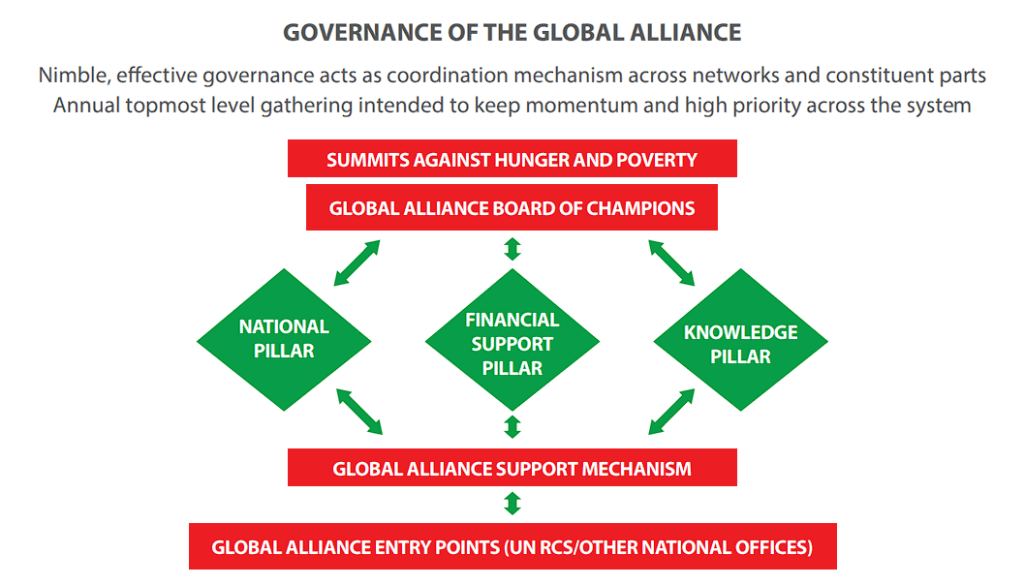
- Effective governance: The Alliance aims to ensure it has a light, simple and effective governance, composed of high-ranking representatives from member countries, organizations and platforms in the development, finance, social protection and food security and nutrition sectors, as well as a small support mechanism to be hosted in an international organization/structure (see Figure 5).
- Promote development cooperation effectiveness: The Alliance seeks to promote country ownership, focus on results, inclusive partnerships, transparency, and mutual accountability, supporting mobilization of resources from a variety of sources to provide adequate and effective means to developing countries to implement programmes and policies to fight poverty and hunger.
- Flexible network operation: At the operational level, the Global Alliance strives to be a facilitator, broker, or matchmaker upon country request, leveraging its multiple partnerships and smartly helping to create a tailored coalition of partners as needed, in support of specific country-led policy It seeks to work as a network of networks, mobilizing, galvanizing, and elevating existing mechanisms and platforms bridging the social protection, poverty reduction and food security and nutrition communities, as well as the development, finance, and humanitarian communities.
Membership
- UN Member and Observer States and G20 members;
- United Nations and its associated bodies, programs, and specialized agencies;
- Other regional and international intergovernmental organizations;
- National, regional and international aid and development agencies;
- National, regional and international development banks;
- International funds, and other trust funds;
- Local, national, regional and international think tanks, research centers, academia and other knowledge organizations;
- Philanthropic organizations;
- International platforms, mechanisms, networks, initiatives, collectives, and civil society organizations.
The reference basket of policy instruments
To keep the Alliance’s focus on the national program level, a reference basket of evidence- based programmes and policy instruments lies at the core of every concrete action by the Global Alliance at the country level. The basket is a living database, built collectively by the Alliance’s members and maintained by the Global Alliance’s Support Mechanism based on a set of inclusion criteria, including evidence of impact, and a standardized template for the information that composes each submission for inclusion to the basket. Inclusion of programmes and policy instruments in the basket does not imply endorsement by any Alliance member of any particular instrument or programme.
The basket serves as the basis for the concrete contributions by each Alliance member to the fight against hunger and poverty, within their respective capacities and roles, either as implementing governments or as supporters with financial resources and/or knowledge (including capacity-building and strengthening, training, technical assistance, etc.).
Constituent Pillars
According to their different nature and capacities, the Global Alliance’s members join one or more of the following three Pillars through tailored Statements of Commitment:
National Pillar
All UN member and observer States and G20 members that have issued the Alliance’s Statements of Commitment collectively integrate its National Pillar. Only such States/ national governments and G20 members can integrate the National Pillar. In addition, these members can also opt to join the Alliance’s other two Pillars by filling in the corresponding section of the Statements of Commitment.
Commitments under the National Pillar relate to a) the adaptation and implementation in the National Pillar participant’s territory of any number of policies in the Alliance’s reference basket, including a commitment to improving their domestic resourcing and financing when necessary and possible, while respecting international obligations; and/or
b) to supporting other countries in implementing similar policies and policy instruments, including via technical cooperation, knowledge sharing (voluntary, on mutually agreed terms), South-South and trilateral cooperation or other modalities of assistance. More specific commitment to support other countries can be made via national finance and knowledge institutions, as relevant.
Financial Support Pillar
The Alliance’s Financial Support Pillar is composed of a wide variety of supporting entities, including global and regional funds, development agencies, and public and private donors, which have made a general commitment, under their own rules and mechanisms, to support Alliance member countries in their own national commitments to implement hunger and poverty reduction programs and policy instruments in the Alliance’s reference policy basket. Specific commitments can be made at country level for specific policy implementation plans, under different, flexible arrangements appropriate to each situation and subject to the full approval of the implementing government.
In making resourcing decisions, the Financial Support Pillar entities and institutions may wish to prioritize, to the extent possible, the poorest countries and those most in need. The Alliance’s Financial Pillar could also be joined by additional multilateral and bilateral resources and funds, as well as possible innovative financial mechanisms and responsible private sector investment in line with the Alliance’s goals and approaches as well as the priorities of implementing countries.
As members of the Global Alliance, institutions, and funds responsible for the management or allocation of funds should make efforts to articulate, enhance coordination and where relevant pool resources in a flexible manner, through partnerships or other means, towards improving delivery and scale for country level implementation of proven programs and policy instruments. Any dedicated resource pooling facility, virtual fund or other mechanism should be optional and voluntary and should not compete for resources with existing mechanisms.
The Global Alliance Support Mechanism advances the Alliance’s role as a facilitator, broker, or matchmaker, by helping to plan and create or reinforce ad hoc partnerships among different institutions to achieve sufficient scale to support a specific country- level policy implementation.
Knowledge Pillar
The Alliance’s Knowledge Pillar includes reputable national, regional, and international institutions, including academic institutions, dedicated to promoting knowledge generation, technical assistance, and voluntary knowledge sharing on mutually agreed terms among Alliance members. Drawing on past Group of 20 and other collective efforts, the Knowledge Pillar institutions, with the support of the Alliance’s Support Mechanism, can leverage and build on a number of existing information and knowledge platforms.
The actions of the Knowledge Pillar should take place primarily at the country level, aiming to strengthen capacity, build knowledge, and share advice and lessons to support governments to achieve SDG 1 and 2 through a successful, quality implementation of effective national policies and programmes that are informed by the reference basket.
As in the case of the Financial Support Pillar, the Global Alliance Support Mechanism advances the Alliance’s role as a facilitator, broker, or matchmaker, by helping to plan and create ad-hoc partnerships among different institutions as necessary to support a specific country level policy implementation
1.2. Governance
As stated in the Guiding Principles section, the Global Alliance aims to have a light and agile governance structure dedicated to support and guide the three Pillars so that they fulfill their intended roles. These are the main governance mechanisms for the Alliance:
Summit against Hunger and Poverty
The Summit against Hunger and Poverty is the main instance responsible for the Alliance’s goal of providing sustained high-level thrust to accelerate action towards SDGs 1 and 2, while reducing inequalities (SDG 10). It may be convened regularly at high level (e.g. the Head of State/Government level), on the side of the UN General Assembly and/or during future G20 Summits, at the invitation of the country chairing the Alliance’s Board of Champions and/ or the current G20 Presidency. It reviews global progress towards the Alliance’s objectives, showcases the Alliance’s accomplishments during the past year(s), issues high-level guidance for the Alliance’s members and their commitments across the three Pillars, and provide an opportunity for further commitments and actions. Members of the Alliance may also echo the achievements made under the Alliance on policy implementation in the high- level events on hunger and poverty which they could organize or take part to.
Board of Champions
- Championing the fight against hunger and poverty and helping communicate the Global Alliance’s work and approach, including at relevant international fora and summits;
- Championing and monitoring the full implementation of the commitments articulated under the Statements of Commitment by their respective country/entity;
- With help from the Support Mechanism, and upon demand, seeking to identify, negotiate, remove roadblocks and facilitate flexible partnerships among different Global Alliance entities, including for supporting a specific country- level policy implementation;
- Raising awareness about the Global Alliance among potential new partners;
- Providing guidance to the development of the Global Alliance and its activities;
- Through its Chairperson and Core Group, overseeing the Global Alliance Support Mechanism, including its Director, and ensuring guidance and accountability;
- When necessary, by consensus of the Board, upon request of concerned member States, approving applications to join the Alliance from non-governmental entities, after consultation with concerned governments;
- Through its Chairperson and Core Group, and with help from the Support Mechanism, liaising with and providing reports and suggestions to the G20, including Finance and Development Ministers, as well as receiving their guidance and input;
- Through its Chairperson and Core Group, and with help from the Support Mechanism, liaising with and providing reports and suggestions to the CFS, as well as receiving the CFS’s guidance and input;
- Reporting to and helping to inform the agenda for the Summits against Poverty and Hunger.
- Up to 25 representatives of UN member or observer States and G20 members representing a diverse range of development stages, geography and regions;
- Up to 1 representative each of FAO, IFAD, ILO, IMF, UNDP, UNICEF, UNIDO, WHO, WFP and the World Bank, along with the CFS Chairperson;
- Up to 6 representatives of other regional or multilateral development banks, funds, or financial institutions;
- Up to 6 representatives of other national regional or international knowledge institutions;
- The Director of the Global Alliance Support Mechanism (in an ex-officio capacity).
- Being nominated by an Alliance member;
- Holding a position in the nominating entity of at least the level of Director, Undersecretary, Board member, or equivalent;
- Committing to dedicate time and attention to foster the mission and goals of the Alliance and carrying out the Board of Exponent’s responsibilities as stated above; and
- Ensuring balance among constituencies of the Alliance, stages of development and geographical representation, with country government representatives ideally composing at least half of the Board of Champions’
Global Alliance Support Mechanism
- Maintaining an operative online platform with streamlined access to knowledge and support channels for Alliance member countries regarding policy implementation, including, as appropriate, partnering with and incorporating existing knowledge and information platforms;
- Curating and maintaining the reference basket of policy instruments and programmes of the Global Alliance, based on submissions by Global Alliance members and guided by the approved inclusion criteria, including evidence of impact, and standardized template, using an electronic interactive platform;
- Supporting the organization of the Global Summits against Hunger and Poverty, in coordination with the UN and its relevant bodies, programmes and agencies, and/or future G20 Presidencies, as appropriate;
- Upon country demand, in coordination with country-level entry points, and with help from the Board of Champions, operating as the central link, facilitating, brokering and nurturing flexible partnerships between national governments wishing to deliver on their commitments to implement policies in the reference policy basket, on one side, and other Global Alliance members that can provide financial or technical support, on the other;
- Supporting the promotion of the Global Alliance achievements in relevant international fora and summits;
- Preparing and supporting Board of Champions and Core Group meetings;
- Under direction from the Board of Champions and its Core Group, and leveraging knowledge partners, helping collect, commission and spread specific work and analysis to foster the Alliance’s goals and operationalize its principles;
- Communicating and liaising with the broad Alliance membership, including informing Alliance members of new and potential members, and receiving suggestions and concerns by member States;
- With information and support from its member countries and organizations, collecting, organizing, and monitoring ongoing results from the Alliance’s global, regional and country-level partnerships and provide annual reports on progress; and
- Under direction from the Board of Champions and its Core Group, liaising with and providing reports and suggestions to the G20, including Finance, Development, and Agriculture Ministers, as well as receiving their possible guidance and input.
Country level Entry points
Also key to the Alliance’s work, the country level entry points offer a convenient, but not exclusive, local point of contact for Alliance country governments reaching out to seek support for implementing the designated policy instruments. The country entry points liaise with the Support Mechanism, helping to facilitate the relevant partnerships. To avoid the establishment of new bureaucracies, the role of the Alliance’s country-level entry points may be filled by a representative of the UN Country Team in each country, to be designated on a country-by-country basis, on a fully voluntary basis with no additional costs, provided that role fits in the UN Country Team’s current mandates and workplans. Consistently with the principle of country-leadership, the country level entry points should act only in support of and in alignment with national government priorities and choices, as long as they are within the Global Alliance’s goals and approach. In some cases, and when there is a perceived need, policy-specific focal points may be designated for supporting country level implementation of select policy instruments, based on government priorities.
Country-level operational principles
The Global Alliance should observe the following principles in its operations at national level:
National governments and country platforms at the center
National governments should be at the front and center of the Alliance’s actions at country level. All such actions should only take place upon country request, in a demand-driven manner. Consistent with the principles of country-ownership, flexibility and avoidance of duplication, the Global Alliance, with support from its country level entry points and Support Mechanism, should make all efforts to work with already existing country platforms which can work in poverty and hunger reduction (including those platforms called for in the context of the G20 Reference Framework for Effective Country Platforms). Where a suitable country platform does not exist, the Global Alliance, in coordination with all relevant entities, can, upon request, support the interested country government in establishing one if that is considered a means to facilitate, and not delay, concrete partnerships for at scale implementation and knowledge exchange. Country platforms should be established for the purpose of consistent programme implementation and financial and technical support, with the interested national government at the center of a tailored coalition of knowledge and financial partners, strategically leveraging existing national-level development dialogues, programmes, and partnerships.
Ensuring Accountability and Lessons Learned
The Global Alliance should work with both the implementing government and partners so that programme and policy implementation plans give full consideration to lessons- learned, accountability, audit and oversight for both countries and partners, including the provision of adequate monitoring and evaluation components that consider complex and diverse demographics.
Ensure due consideration of specific circumstances and people in vulnerable situations
The Global Alliance should work with both implementing government and partners so that programme and policy implementation plans take full consideration of the specific circumstances of the poorest and people in vulnerable situations, with particular attention to women, children and youth, smallholder and family farmers, migrants, Indigenous Peoples and local communities, persons with disability, and those living in rural and landlocked areas, among others, with a view to reduce inequalities and reflect particular risks, needs and life situations.
Promote open, inclusive dialogue with involved populations and stakeholders
The Global Alliance should work with both implementing government and partners so that policy and programme implementation plans embed, to the extent possible, inclusive dialogue and informed consultations with all relevant stakeholders, most particularly the populations and groups that are the object of policy instruments and programmes under consideration. In the case of private sector involvement in public programme and policy instrument implementation, through public-private-partnerships or other means, provisions should be made to avoid conflicts of interest and ensure alignment with policy objectives.
Avoiding negative impacts, enabling synergies, and managing trade-offs
The Global Alliance should work with both implementing governments and partners so that policy and programme implementation plans include appropriate considerations and measures to enable and reinforce positive synergies and to avoid potential negative social and environmental impacts or unintended consequences of any policy instrument implementation or intervention, take full consideration of interlinkages across Sustainable Development Goals, and promote a balanced management of any existing trade-offs.
1.3. Organizational schematics
FIGURE 1. Global level partnership building

FIGURE 2. Country level operations
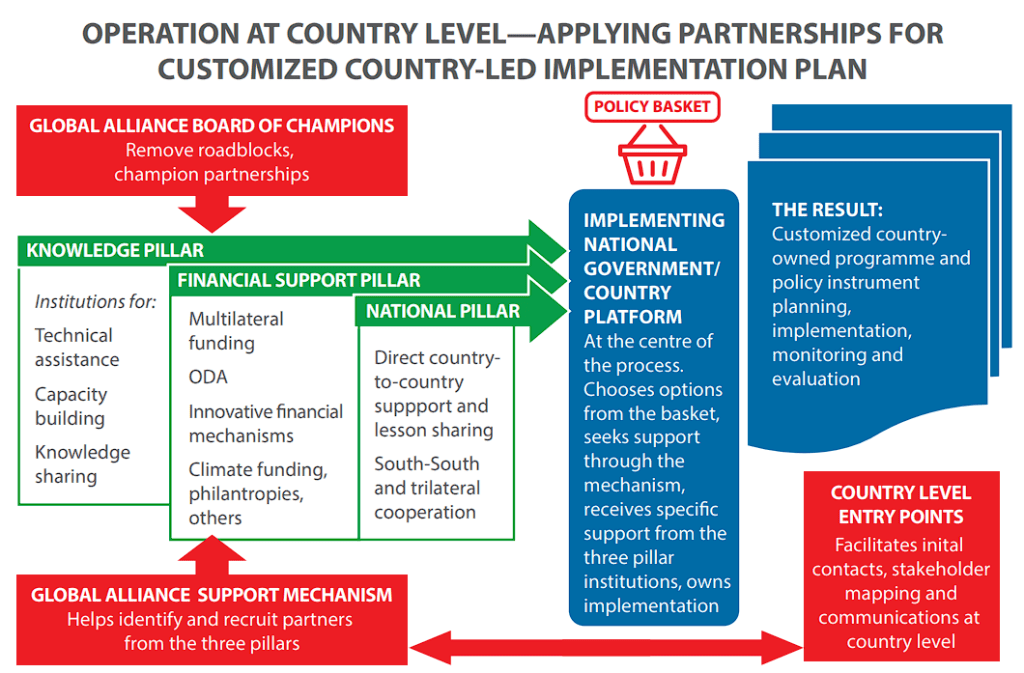
FIGURE 3. Focus on implementation of scaled-up policy instruments and
programmes instead of small projects or broad-based strategies/plans/frameworks
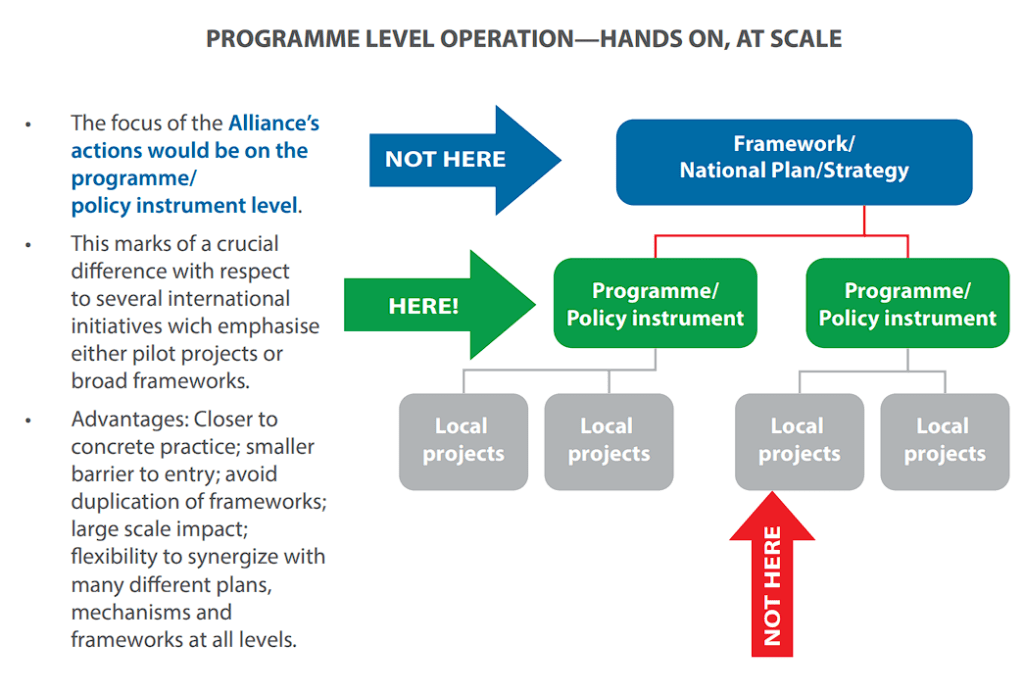
FIGURE 4. Governance mechanisms
Notes
- The hosting arrangement and hiring process should abide by the rules and regulations of the hosting international organization.
Foundational Documents
Download the full document
GLOBAL ALLIANCE AGAINST HUNGER AND POVERTY— TERMS OF REFERENCE AND GOVERNANCE FRAMEWORK
NATURE AND PURPOSE OF THIS DOCUMENT (THIS SECTION IS FOR INFORMATION ONLY)
This Terms of Reference and Governance Framework document is a core component of the Global Alliance against Hunger and Poverty. It sets out a description of the proposed mission statement, objectives, guiding principles, membership, component Pillars, decision-making instances, operational mechanism, and broad operational procedures. It is geared at providing high-level terms of reference and framework for the Alliance, without pretending to exhaust all possible details, rules, protocols and/or guidelines that should best be left to be developed as part of the Global Alliance’s activities, based on concrete experience and needs.
1. GOVERNANCE FRAMEWORK
1.1. Founding aspects
Mission Statement
From its launch until 2030, support and accelerate efforts to eradicate hunger and poverty (SDGs 1 and 2) while reducing inequalities (SDG 10) and contributing to revitalize global partnerships for sustainable development (SDG 17) and to the achievement of other interlinked SDGs, and championing sustainable, inclusive, and just transition pathways.
High-level Objectives
- Provide sustained political drive at the highest level by the Group of 20 and other Global Alliance Members, galvanizing collective action and building upon synergies with other existing efforts to eliminate hunger and poverty across the world.
- Facilitate mobilization and improved alignment of domestic and international support, including public and private financial resources and knowledge, to enable large-scale country-owned and country-led implementation of evidence-based programmes and policy instruments, especially by countries most affected by hunger and extreme poverty and focusing on persons in vulnerable situations and those most likely to be left behind.
Guiding Principles:
- Open membership and voluntary participation: The Alliance is open to membership to any UN member or observer state or G20 member, as well as a wide variety of national, regional, and international finance, knowledge sharing and capacity building organizations and initiatives. Membership in the Global Alliance is formalized through the issuance of tailored Statements of Commitment (See Figure 2).
- Demand-driven, putting country needs first: The Alliance seeks to respond to country priorities and requests for support to implement programmes or policy instruments that are aligned wi th its priorities and listed on the Alliance reference basket. Implementation plans for specific instruments are ultimately to be guided and owned by national governments, with support from the Global Alliance (see Figure 3).
- Action-driven, focused on the “how”: The Alliance focuses on promoting collective support and accelerating policy-driven action at the country It operates at the policy instrument level, supporting bottom-up, country-driven, flexible implementation based on a reference basket of policy instruments, from which countries choose for adaptation to national circumstances. It does not build new global, top-down priorities, targets, or action plans, working instead to support implementation of existing commitments. It does not create additional fora or working groups for policy debate or convergence, recognizing the legitimacy and sufficiency of existing multilateral mechanisms. It aims to support the achievement of SDGs 1 and 2, as well as, to contribute to SDG 10 and other interlinked SDGs as much as possible through design and implementation features of programmes and policy instruments focused on SDG 1 and 2 that incorporate elements which enhance their positive effects and/or avoid any potential negative impacts on other SDGs. Moreover, the Alliance relies on existing targets and indicators, including those of SDGs, and does not propose new global high-level goals, targets, or metrics (see Figure 4).
- Effective governance: The Alliance aims to ensure it has a light, simple and effective governance, composed of high-ranking representatives from member countries, organizations and platforms in the development, finance, social protection and food security and nutrition sectors, as well as a small support mechanism to be hosted in an international organization/structure (see Figure 5).
- Promote development cooperation effectiveness: The Alliance seeks to promote country ownership, focus on results, inclusive partnerships, transparency, and mutual accountability, supporting mobilization of resources from a variety of sources to provide adequate and effective means to developing countries to implement programmes and policies to fight poverty and hunger.
- Flexible network operation: At the operational level, the Global Alliance strives to be a facilitator, broker, or matchmaker upon country request, leveraging its multiple partnerships and smartly helping to create a tailored coalition of partners as needed, in support of specific country-led policy It seeks to work as a network of networks, mobilizing, galvanizing, and elevating existing mechanisms and platforms bridging the social protection, poverty reduction and food security and nutrition communities, as well as the development, finance, and humanitarian communities.
Membership
- UN Member and Observer States and G20 members;
- United Nations and its associated bodies, programs, and specialized agencies;
- Other regional and international intergovernmental organizations;
- National, regional and international aid and development agencies;
- National, regional and international development banks;
- International funds, and other trust funds;
- Local, national, regional and international think tanks, research centers, academia and other knowledge organizations;
- Philanthropic organizations;
- International platforms, mechanisms, networks, initiatives, collectives, and civil society organizations.
The reference basket of policy instruments
To keep the Alliance’s focus on the national program level, a reference basket of evidence- based programmes and policy instruments lies at the core of every concrete action by the Global Alliance at the country level. The basket is a living database, built collectively by the Alliance’s members and maintained by the Global Alliance’s Support Mechanism based on a set of inclusion criteria, including evidence of impact, and a standardized template for the information that composes each submission for inclusion to the basket. Inclusion of programmes and policy instruments in the basket does not imply endorsement by any Alliance member of any particular instrument or programme.
The basket serves as the basis for the concrete contributions by each Alliance member to the fight against hunger and poverty, within their respective capacities and roles, either as implementing governments or as supporters with financial resources and/or knowledge (including capacity-building and strengthening, training, technical assistance, etc.).
Constituent Pillars
According to their different nature and capacities, the Global Alliance’s members join one or more of the following three Pillars through tailored Statements of Commitment:
National Pillar
All UN member and observer States and G20 members that have issued the Alliance’s Statements of Commitment collectively integrate its National Pillar. Only such States/ national governments and G20 members can integrate the National Pillar. In addition, these members can also opt to join the Alliance’s other two Pillars by filling in the corresponding section of the Statements of Commitment.
Commitments under the National Pillar relate to a) the adaptation and implementation in the National Pillar participant’s territory of any number of policies in the Alliance’s reference basket, including a commitment to improving their domestic resourcing and financing when necessary and possible, while respecting international obligations; and/or
b) to supporting other countries in implementing similar policies and policy instruments, including via technical cooperation, knowledge sharing (voluntary, on mutually agreed terms), South-South and trilateral cooperation or other modalities of assistance. More specific commitment to support other countries can be made via national finance and knowledge institutions, as relevant.
Financial Support Pillar
The Alliance’s Financial Support Pillar is composed of a wide variety of supporting entities, including global and regional funds, development agencies, and public and private donors, which have made a general commitment, under their own rules and mechanisms, to support Alliance member countries in their own national commitments to implement hunger and poverty reduction programs and policy instruments in the Alliance’s reference policy basket. Specific commitments can be made at country level for specific policy implementation plans, under different, flexible arrangements appropriate to each situation and subject to the full approval of the implementing government.
In making resourcing decisions, the Financial Support Pillar entities and institutions may wish to prioritize, to the extent possible, the poorest countries and those most in need. The Alliance’s Financial Pillar could also be joined by additional multilateral and bilateral resources and funds, as well as possible innovative financial mechanisms and responsible private sector investment in line with the Alliance’s goals and approaches as well as the priorities of implementing countries.
As members of the Global Alliance, institutions, and funds responsible for the management or allocation of funds should make efforts to articulate, enhance coordination and where relevant pool resources in a flexible manner, through partnerships or other means, towards improving delivery and scale for country level implementation of proven programs and policy instruments. Any dedicated resource pooling facility, virtual fund or other mechanism should be optional and voluntary and should not compete for resources with existing mechanisms.
The Global Alliance Support Mechanism advances the Alliance’s role as a facilitator, broker, or matchmaker, by helping to plan and create or reinforce ad hoc partnerships among different institutions to achieve sufficient scale to support a specific country- level policy implementation.
Knowledge Pillar
The Alliance’s Knowledge Pillar includes reputable national, regional, and international institutions, including academic institutions, dedicated to promoting knowledge generation, technical assistance, and voluntary knowledge sharing on mutually agreed terms among Alliance members. Drawing on past Group of 20 and other collective efforts, the Knowledge Pillar institutions, with the support of the Alliance’s Support Mechanism, can leverage and build on a number of existing information and knowledge platforms.
The actions of the Knowledge Pillar should take place primarily at the country level, aiming to strengthen capacity, build knowledge, and share advice and lessons to support governments to achieve SDG 1 and 2 through a successful, quality implementation of effective national policies and programmes that are informed by the reference basket.
As in the case of the Financial Support Pillar, the Global Alliance Support Mechanism advances the Alliance’s role as a facilitator, broker, or matchmaker, by helping to plan and create ad-hoc partnerships among different institutions as necessary to support a specific country level policy implementation
1.2. Governance
As stated in the Guiding Principles section, the Global Alliance aims to have a light and agile governance structure dedicated to support and guide the three Pillars so that they fulfill their intended roles. These are the main governance mechanisms for the Alliance:
Summit against Hunger and Poverty
The Summit against Hunger and Poverty is the main instance responsible for the Alliance’s goal of providing sustained high-level thrust to accelerate action towards SDGs 1 and 2, while reducing inequalities (SDG 10). It may be convened regularly at high level (e.g. the Head of State/Government level), on the side of the UN General Assembly and/or during future G20 Summits, at the invitation of the country chairing the Alliance’s Board of Champions and/ or the current G20 Presidency. It reviews global progress towards the Alliance’s objectives, showcases the Alliance’s accomplishments during the past year(s), issues high-level guidance for the Alliance’s members and their commitments across the three Pillars, and provide an opportunity for further commitments and actions. Members of the Alliance may also echo the achievements made under the Alliance on policy implementation in the high- level events on hunger and poverty which they could organize or take part to.
Board of Champions
- Championing the fight against hunger and poverty and helping communicate the Global Alliance’s work and approach, including at relevant international fora and summits;
- Championing and monitoring the full implementation of the commitments articulated under the Statements of Commitment by their respective country/entity;
- With help from the Support Mechanism, and upon demand, seeking to identify, negotiate, remove roadblocks and facilitate flexible partnerships among different Global Alliance entities, including for supporting a specific country- level policy implementation;
- Raising awareness about the Global Alliance among potential new partners;
- Providing guidance to the development of the Global Alliance and its activities;
- Through its Chairperson and Core Group, overseeing the Global Alliance Support Mechanism, including its Director, and ensuring guidance and accountability;
- When necessary, by consensus of the Board, upon request of concerned member States, approving applications to join the Alliance from non-governmental entities, after consultation with concerned governments;
- Through its Chairperson and Core Group, and with help from the Support Mechanism, liaising with and providing reports and suggestions to the G20, including Finance and Development Ministers, as well as receiving their guidance and input;
- Through its Chairperson and Core Group, and with help from the Support Mechanism, liaising with and providing reports and suggestions to the CFS, as well as receiving the CFS’s guidance and input;
- Reporting to and helping to inform the agenda for the Summits against Poverty and Hunger.
- Up to 25 representatives of UN member or observer States and G20 members representing a diverse range of development stages, geography and regions;
- Up to 1 representative each of FAO, IFAD, ILO, IMF, UNDP, UNICEF, UNIDO, WHO, WFP and the World Bank, along with the CFS Chairperson;
- Up to 6 representatives of other regional or multilateral development banks, funds, or financial institutions;
- Up to 6 representatives of other national regional or international knowledge institutions;
- The Director of the Global Alliance Support Mechanism (in an ex-officio capacity).
- Being nominated by an Alliance member;
- Holding a position in the nominating entity of at least the level of Director, Undersecretary, Board member, or equivalent;
- Committing to dedicate time and attention to foster the mission and goals of the Alliance and carrying out the Board of Exponent’s responsibilities as stated above; and
- Ensuring balance among constituencies of the Alliance, stages of development and geographical representation, with country government representatives ideally composing at least half of the Board of Champions’
Global Alliance Support Mechanism
- Maintaining an operative online platform with streamlined access to knowledge and support channels for Alliance member countries regarding policy implementation, including, as appropriate, partnering with and incorporating existing knowledge and information platforms;
- Curating and maintaining the reference basket of policy instruments and programmes of the Global Alliance, based on submissions by Global Alliance members and guided by the approved inclusion criteria, including evidence of impact, and standardized template, using an electronic interactive platform;
- Supporting the organization of the Global Summits against Hunger and Poverty, in coordination with the UN and its relevant bodies, programmes and agencies, and/or future G20 Presidencies, as appropriate;
- Upon country demand, in coordination with country-level entry points, and with help from the Board of Champions, operating as the central link, facilitating, brokering and nurturing flexible partnerships between national governments wishing to deliver on their commitments to implement policies in the reference policy basket, on one side, and other Global Alliance members that can provide financial or technical support, on the other;
- Supporting the promotion of the Global Alliance achievements in relevant international fora and summits;
- Preparing and supporting Board of Champions and Core Group meetings;
- Under direction from the Board of Champions and its Core Group, and leveraging knowledge partners, helping collect, commission and spread specific work and analysis to foster the Alliance’s goals and operationalize its principles;
- Communicating and liaising with the broad Alliance membership, including informing Alliance members of new and potential members, and receiving suggestions and concerns by member States;
- With information and support from its member countries and organizations, collecting, organizing, and monitoring ongoing results from the Alliance’s global, regional and country-level partnerships and provide annual reports on progress; and
- Under direction from the Board of Champions and its Core Group, liaising with and providing reports and suggestions to the G20, including Finance, Development, and Agriculture Ministers, as well as receiving their possible guidance and input.
Country level Entry points
Also key to the Alliance’s work, the country level entry points offer a convenient, but not exclusive, local point of contact for Alliance country governments reaching out to seek support for implementing the designated policy instruments. The country entry points liaise with the Support Mechanism, helping to facilitate the relevant partnerships. To avoid the establishment of new bureaucracies, the role of the Alliance’s country-level entry points may be filled by a representative of the UN Country Team in each country, to be designated on a country-by-country basis, on a fully voluntary basis with no additional costs, provided that role fits in the UN Country Team’s current mandates and workplans. Consistently with the principle of country-leadership, the country level entry points should act only in support of and in alignment with national government priorities and choices, as long as they are within the Global Alliance’s goals and approach. In some cases, and when there is a perceived need, policy-specific focal points may be designated for supporting country level implementation of select policy instruments, based on government priorities.
Country-level operational principles
The Global Alliance should observe the following principles in its operations at national level:
National governments and country platforms at the center
National governments should be at the front and center of the Alliance’s actions at country level. All such actions should only take place upon country request, in a demand-driven manner. Consistent with the principles of country-ownership, flexibility and avoidance of duplication, the Global Alliance, with support from its country level entry points and Support Mechanism, should make all efforts to work with already existing country platforms which can work in poverty and hunger reduction (including those platforms called for in the context of the G20 Reference Framework for Effective Country Platforms). Where a suitable country platform does not exist, the Global Alliance, in coordination with all relevant entities, can, upon request, support the interested country government in establishing one if that is considered a means to facilitate, and not delay, concrete partnerships for at scale implementation and knowledge exchange. Country platforms should be established for the purpose of consistent programme implementation and financial and technical support, with the interested national government at the center of a tailored coalition of knowledge and financial partners, strategically leveraging existing national-level development dialogues, programmes, and partnerships.
Ensuring Accountability and Lessons Learned
The Global Alliance should work with both the implementing government and partners so that programme and policy implementation plans give full consideration to lessons- learned, accountability, audit and oversight for both countries and partners, including the provision of adequate monitoring and evaluation components that consider complex and diverse demographics.
Ensure due consideration of specific circumstances and people in vulnerable situations
The Global Alliance should work with both implementing government and partners so that programme and policy implementation plans take full consideration of the specific circumstances of the poorest and people in vulnerable situations, with particular attention to women, children and youth, smallholder and family farmers, migrants, Indigenous Peoples and local communities, persons with disability, and those living in rural and landlocked areas, among others, with a view to reduce inequalities and reflect particular risks, needs and life situations.
Promote open, inclusive dialogue with involved populations and stakeholders
The Global Alliance should work with both implementing government and partners so that policy and programme implementation plans embed, to the extent possible, inclusive dialogue and informed consultations with all relevant stakeholders, most particularly the populations and groups that are the object of policy instruments and programmes under consideration. In the case of private sector involvement in public programme and policy instrument implementation, through public-private-partnerships or other means, provisions should be made to avoid conflicts of interest and ensure alignment with policy objectives.
Avoiding negative impacts, enabling synergies, and managing trade-offs
The Global Alliance should work with both implementing governments and partners so that policy and programme implementation plans include appropriate considerations and measures to enable and reinforce positive synergies and to avoid potential negative social and environmental impacts or unintended consequences of any policy instrument implementation or intervention, take full consideration of interlinkages across Sustainable Development Goals, and promote a balanced management of any existing trade-offs.
1.3. Organizational schematics
FIGURE 1. Global level partnership building
FIGURE 2. Country level operations
FIGURE 3. Focus on implementation of scaled-up policy instruments and
programmes instead of small projects or broad-based strategies/plans/frameworks
FIGURE 4. Governance mechanisms
Notes
- The hosting arrangement and hiring process should abide by the rules and regulations of the hosting international organization.