Brazilian President Luiz Inácio Lula da Silva and FAO Director- General Qu Dongyu opened the meeting in Rome where Champions appointed the Support Mechanism Director and renewed high-level commitments to accelerate global efforts to end hunger and poverty by 2030.

Installing the Support Mechanism of the Global Alliance Against Hunger and Poverty, assessing progress, and defining next steps — these were among the key topics discussed on Monday (October 13) during the Second Meeting of the Board of Champions of the Alliance, held at the headquarters of the Food and Agriculture Organization of the United Nations (FAO) in Rome, Italy.
The event was attended by President Luiz Inácio Lula da Silva, the Co-Chairs of the Board, Brazilian Minister for Social Development and Assistance, Family and Fight against Hunger Wellington Dias and Spanish Secretary of State for International Cooperation Eva Granados, the Director-General of the Food and Agriculture Organization of the United Nations (FAO), Qu Dongyu, among other authorities.
In his speech, President Lula strongly emphasized the need for wealthy nations to prioritize the fight against hunger over spending on weapons.
“It is unacceptable that those of us fighting for equality, against prejudice and inequality, watch the rich world spend US$ 2.7 trillion on weapons while failing to invest the same amount to combat hunger and misery. There’s simply no explanation for that,” he stated.
The President criticized the recent surge in military investments, questioning the logic that more weapons can end wars.
“Wars don’t end with more weapons — they end with more food, more jobs, more harmony, and more peace. That’s what truly ends wars,” he said. Lula stressed that humanity must be “moved to indignation by hunger — an unacceptable condition in a world that produces enough food for everyone.”
The President also addressed implementing national governments on the need for integrating social policies into domestic budgets.
“It is time to include the poor in the budget. Social inclusion cannot be just a promise — it needs to be reflected in fiscal architecture, public investments, and productive transformation plans.”
Additionally, the Brazilian Head of State highlighted the link between climate action and the fight against hunger and poverty, announcing the goal of launching a declaration on hunger, poverty and climate at COP30.
“At COP30 in Belém, we want to adopt a Declaration on Hunger, Poverty and Climate. Food security must be at the heart of climate action. Nationally Determined Contributions must include social protection, smallholder resilience and solutions that generate income and preserve biodiversity. Only a new model of fair and sustainable development can ensure a future for the next generations.”
Minister Wellington Dias highlighted Brazil’s experience in food security and President Lula’s leadership in creating the Alliance during Brazil’s G20 presidency.
“It is an honor to represent Brazil, alongside Spain, in coordinating the Board of the Global Alliance Against Hunger and Poverty. Today is a special day — we are officially launching the Alliance’s Support Mechanism,” he celebrated.
Dias presented data illustrating the magnitude of the challenge to end hunger.
“In 2023, the world had 735 million people living with hunger. In 2024, that number dropped slightly to 673 million. This shows that with commitment, financial support, and shared knowledge, we can achieve much more,” he said.
In less than a year, the Global Alliance Against Hunger and Poverty has brought together 201 members — 105 countries and 96 organizations — with ambitious goals for 2030, including reaching 500 million people through income transfers and ensuring high-quality school meals for an additional 150 million children.
During the event, Co-Chair Eva Granados advocated for anti-hunger actions based on inclusive public policies and solid financial frameworks. She also highlighted progress toward the Seville Commitment and other milestones linked to the 2030 Agenda, while acknowledging that more effort is needed.
“There is still much to be done. Now we must continue insisting on the effective implementation of our commitments. We need to move from words to action — and that’s where the next steps of the Alliance are so crucial,” she said.
Granados also mentioned progress in developing Operational Plans and Accelerated National Plans for pilot countries, as well as in mobilizing technical and financial support.
“We must ensure proper follow-up mechanisms and reliable indicators. This is where the Support Mechanism plays a vital role. We must remain consistent with our commitments and ensure accountability,” she added.
FAO Director-General Qu Dongyu praised Brazil’s leadership and contribution to global food security and emphasized the Alliance’s importance in addressing global hunger and poverty.
“Brazil’s leadership in creating the Global Alliance Against Hunger and Poverty — particularly during its G20 presidency — was historic. Projections indicate that 512 million people could be chronically undernourished by 2030, nearly 60% of them in Africa. In 2024, around 2.3 billion people faced moderate or severe food insecurity. We must confront this challenge, and the Global Alliance Against Hunger and Poverty is both timely and undeniable,” he said.
Launch of the Support Mechanism
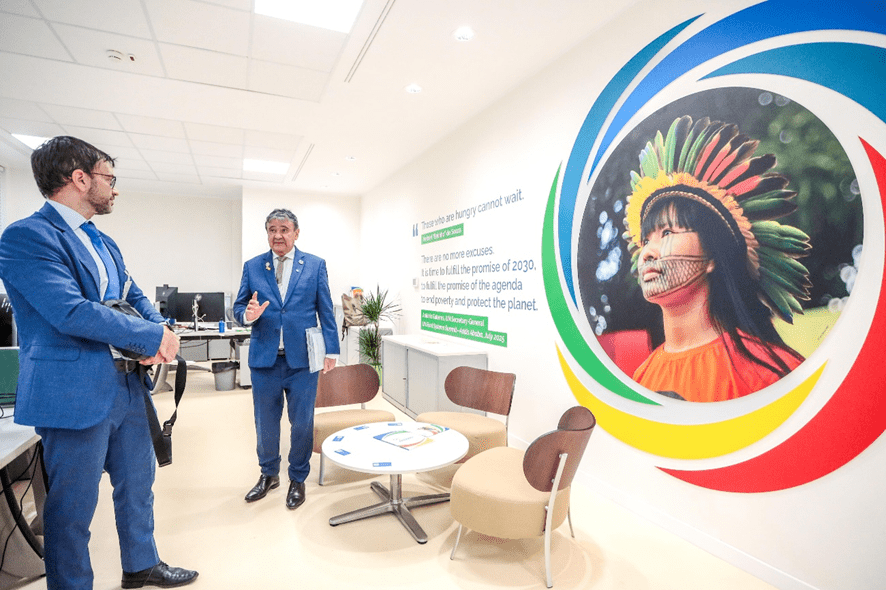
On Monday, President Lula, accompanied by Wellington Dias, inaugurated the office that will host the Support Mechanism of the Global Alliance, which will serve as the Alliance’s secretariat at FAO headquarters in Rome.
Brazilian diplomat Renato Domith Godinho, Head of the International Affairs Office at Brazil’s Ministry of Social Development (MDS) and newly appointed Director of the Support Mechanism, explained that the team’s mission is to coordinate efforts among the Alliance’s 200+ members. The Mechanism will have 15 professionals based in offices around the world, with its main headquarters in Rome.
“The Support Mechanism is a team — a small team facing the major challenge of accelerating the Alliance’s efforts to end hunger and poverty by 2030,” Godinho said.
The Mechanism will support the implementation of national programs, facilitate partnerships and knowledge exchange — including successful Brazilian experiences such as Bolsa Família and school feeding programs — and mobilize financial resources.
Next Steps
The Global Alliance is preparing its First Leaders’ Meeting, to be held on November 3 in Doha, Qatar, on the sidelines of the Second United Nations World Summit for Social Development. The meeting will review global progress, showcase achievements over the past year, set strategic directions for member countries, and encourage new commitments in the fight against hunger and poverty.
Following the Second World Summit for Social Development, Alliance members and other UNFCCC parties will meet in Belem, Brazil, to launch the Leaders’ Declaration on Hunger, Poverty and Human-Centred Climate Action. The Declaration’s text was negotiated at the Alliance’s Board of Champions throughout the past months before being submitted to broader endorsement.
The Board of Champions, co-chaired by Brazil and Spain and composed of up to 50 high-level members, guides the Alliance’s actions and influences decision-making across partner institutions. The first Board meeting took place in February 2025, on the margins of the 48th Governing Council of the International Fund for Agricultural Development (IFAD).
President Lula’s delegation to Rome included Ministers Mauro Vieira (Foreign Affairs) and Paulo Teixeira (Agrarian Development and Family Farming). The event was also attended by Ethiopia’s Ambassador, Demitu Hambisa Bonsa.