Governments and development partners in Rome highlight coordination and financing gaps slowing progress on hunger and malnutrition among vulnerable children and communities
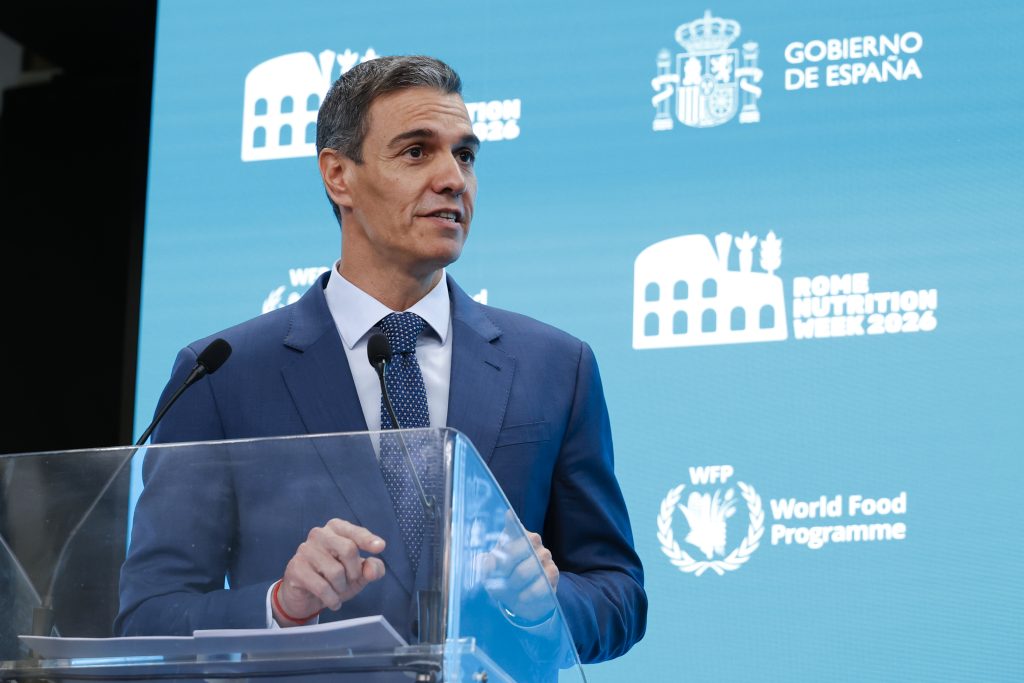
Rome, Italy, 27 May 2026 – Speaking at a High-Level Session at Rome Nutrition Week yesterday, Pedro Sánchez, Prime Minister of Spain issued a renewed call to place hunger higher on the global agenda, warning that persistent malnutrition undermines long-term development.
“Malnutrition does not merely rob millions of children of their present,” he said. “It robs them of something far more precious: their future before they even know they have one,” he warned.
Prime Minister Sánchez outlined the country’s approach to addressing hunger and commitment to renewed, effective and inclusive multilateralism through the Global Alliance against Hunger and Poverty, which Spain co-chairs alongside Brazil.
Opening the session, FAO Director‑General QU Dongyu underscored the urgency of acting early to prevent worsening food crises. “Food crises do not begin when shelves are empty,” he said. “They begin when farmers cannot plant, when fertilizers become unaffordable, and when vulnerable households lose their purchasing power.” His remarks highlighted the interconnected nature of today’s shocks and the growing pressures on agrifood systems worldwide.
Throughout the week, speakers emphasized that progress on nutrition depends on stronger alignment between policies, investments and delivery systems, an area where many agree efforts remain fragmented. With millions still unable to afford a healthy diet, Rome Nutrition Week has focused on identifying practical pathways to move from dialogue to coordinated, system-wide solutions.
Hungry children need more than piecemeal financing
At a side event on integrated nutrition financing, governments and development partners highlighted that persistent fragmentation leaves millions of vulnerable children and communities unreached.
The session, convened by Results 4 Development, Scaling Up Nutrition Secretariat, SDG2 Advocacy Hub and World Vision International in collaboration with Brazil, Pakistan and Zambia, explored pathways to strengthen financing, accountability and policy coherence to address malnutrition. Discussions highlighted different country experiences, pointing to the importance of aligning investments across health, agriculture, social protection and education systems to deliver sustained nutrition outcomes.
These discussions reflect a broader shift underway towards better integrated financing across institutions and sectors, recognizing that no single actor can address the intersected challenges of hunger and poverty alone. This sentiment has taken root among members of the Global Alliance, who are developing a practical framework to align development, humanitarian and climate finance with country-led efforts against hunger and poverty.
As Rome Nutrition Week continues, the message from leaders is clear: advancing the fight against hunger and poverty will require both renewed political momentum and more integrated approaches to financing and delivery.
For governments and development actors, this means closer collaboration to translate commitment into practical, coordinated solutions that accelerate progress towards ending hunger and poverty in all their forms.