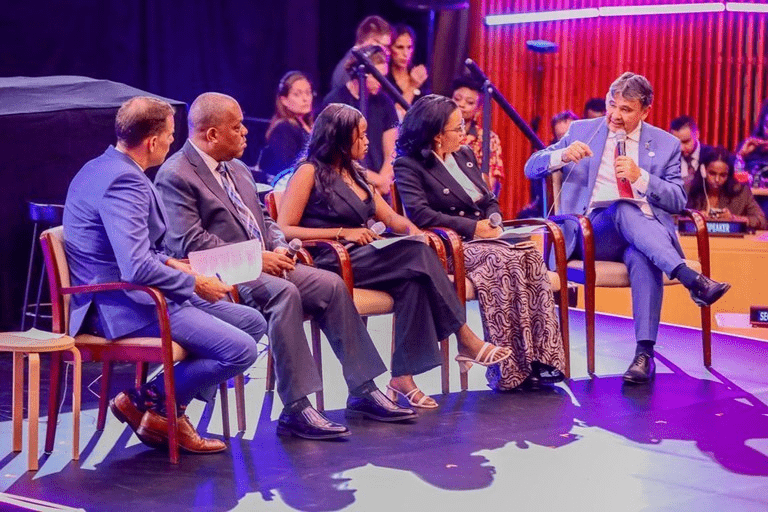

WASHINGTON, D.C. – During the 2025 IMF/World Bank Annual Meetings, the Office of the Executive Director for Brazil at the World Bank (EDS15), in partnership with the Global Alliance against Hunger and Poverty, convened a high-level roundtable to address critical financing challenges in the fight against hunger and poverty1. The event, titled “Shifting Gears: Financing Fast Track Hunger & Poverty Reduction,” brought together representatives of finance ministries, Multilateral Development Banks (MDBs) leaders, and World Bank Executive Directors for Tanzania (EDS 25) and Nigeria (EDS14) as well as some Country Directors for a candid, closed-door discussion on scaling up social protection systems
The event was opened by Marcos Vinicius Chiliatto, World Bank Executive Director for Brazil, who welcomed the participants and underscored the importance of partnerships such as the Global Alliance against Hunger and Poverty, that already counts with 204 members, including 14 international finance organizations in advancing the fight against hunger and poverty, especially in a complex global environment marked by high interest rates and tightening financial constraints. He framed the discussion as a collective endeavor to ensure social protection policies deliver high economic returns for societies.
Ambassador Tatiana Rosito, Brazil’s Vice Minister of Finance highlighted Brazil’s own pathbreaking social protection investments as a catalyst for the Global Alliance’s mission. Mamta Murthi, World Bank Vice President for People, reinforced the urgency, noting that “at this moment of change and fiscal stress, the work of the G20-born Global Alliance puts an emphasis on the foundational objectives of poverty and hunger – and how these investments link to creating jobs and opportunities”.
Country Leadership at the Forefront of Financing Debate
A central theme of the roundtable was the challenge of mobilizing domestic resources amid significant fiscal constraintsand how concessional funds can support countries in building systems and capacities do achieve SDG 1 and 2 targets. Representatives from Haiti, Rwanda, Somalia, Sierra Leone, and Bangladesh shared firsthand experiences in navigating this complex landscape. Many highlighted ongoing fiscal reforms and dedicated efforts to protect and “ringfence” budgetary resources for social protection, particularly for adaptive systems that can respond to climate shocks.
The discussion underscored that country ownership is the foundation for sustainable change. Standout interventions from Haiti, Rwanda, and Somalia demonstrated deep engagement with their national strategies to scale-up social protection systems:
- Haiti’s Minister of Economy and Finance, Mr. Alfred Metellus, detailed the country’s Fast Track implementation plan. He explained that the plan, supported by the Global Alliance with financing from the Inter-American Development Bank, the World Bank, and Brazil, is designed not only as a safety net but as a mechanism to stimulate the local economy by creating jobs and supporting small and medium-sized enterprises (SMEs).
- The head of development finance department at the Ministry of Finance and Economic Planning of Rwanda, Mr. Gerald Cyubahiro, highlighted Rwanda’s Vision Umurenge Program (VUP) as a leading example of a government-led graduation model as a social protection-based platform capable of empowering citizens and its commitment to significant domestic resource allocation for its Fast Track plan.
- In a powerful intervention, Dr. Hodan Osman, President of the Somalia Development Bank, emphasized the importance of the state being in the “driving seat” of its social protection agenda. She spoke on the need to ensure the financial sustainability of the national Baxnaano program and detailed government plans to gradually increase domestic budget allocations while also exploring other sources of finance, such as Zakat in Islamic countries and climate finance. She also highlighted the importance of the Global Alliance’s mobilization capacity at a critical moment of declining ODA funds worldwide.
A Call for Strategic Alignment from Multilateral Partners
Ministers stressed the vital role of concessional financing, especially through IDA21, not merely as a source of funds but as a catalyst for building more efficient and integrated social protection delivery systems that foster job creation and economic growth.
The MDBs responded with strong messages of support. The African Development Bank (AfDB) was recognized as a key partner, with Vice President Nnenna Nwabufo expressing the Bank’s interest in supporting the Fast Track implementation plans of at least four countries: Zambia, Ethiopia, Kenya, and Benin. Mr. Ferdinando Regalia, Inter-American Development Bank’s manager of the Social Sector also reaffirmed IDB commitment to the Alliance’s mission and to Haiti implementation plan.
The event concluded with a powerful call to action centered on the World Bank’s ambitious SP500 target—a commitment to expand social protection and employment support to an reach 500 million people by 2030. Iffath Sharif, the World Bank’s Global Director for Social Protection and Jobs, invited all MDBs to partner with the World Bank to mobilize the resources and knowledge needed to achieve this crucial goal, leveraging the political momentum of the Alliance to drive tangible results for the world’s most vulnerable people.