In the face of aid cuts, global crises, and fragmented initiatives, the Head of Brazil’s Ministry of Social Development defended the fundamental value of international cooperation for economic and social development.
Paris, France, 12 May 2026 – “While humanity faces interconnected crises, the world is reducing the instruments created to respond to them. For many, this means more expensive food, interrupted services, and an uncertain future.” With these words, the Minister of Development and Social Assistance, Family and Fight against Hunger (MDS), Wellington Dias, defended “the fundamental value of international cooperation” and reinforced the need for a global architecture capable of connecting financing, knowledge, and implementation support around national strategies.
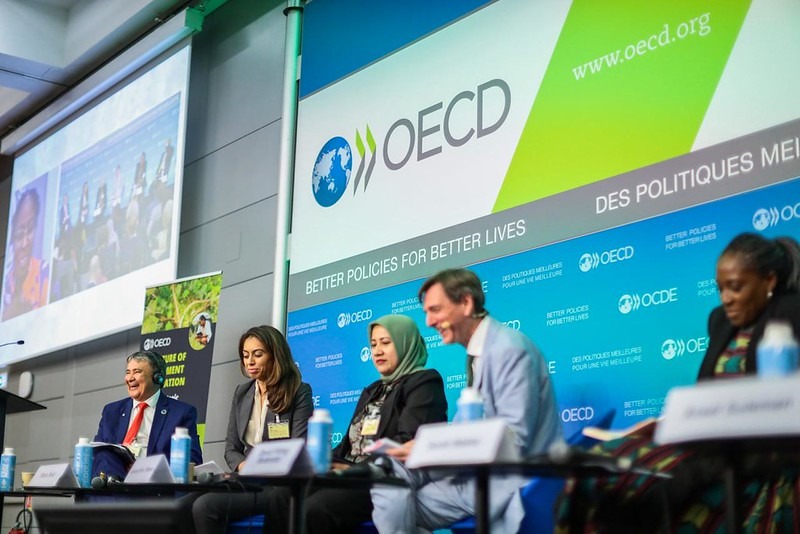
The appeals were made this Monday (May 11th) during a panel at the Organization for Economic Cooperation and Development (OECD) Conference on the Future of International Cooperation for Development, in Paris. The meeting brings together political leaders, policymakers, representatives from the private sector and civil society to discuss the challenges and transformations of international cooperation in a scenario of geopolitical and economic changes. The focus is on strategies to broaden the impact of development policies, promote inclusive economies, and strengthen actions to combat hunger and poverty. Data from the panel showed that geopolitical and economic instability is converging with a historic decline in official development assistance, which fell by 23.1% between 2024 and 2025, with projections of further reductions. Added to budget cuts in multilateral organizations, which threaten to trigger failures in service delivery, these forces exacerbate pre-existing weaknesses and drive the increase in unproductive debt, poverty, and inequality. Faced with this reality, Minister Wellington Dias stressed the need to no longer operate under the premises of the past, but under a new generation, more practical and guided by the priorities of the countries, capable of delivering concrete results on a large scale, with the fight against hunger at the center of this effort. “The fight against hunger and poverty must remain at the center of this effort—not only as a moral imperative, but because it is an essential condition for stability, resilience, peace, and democracy,” he stated.
In his speech, he recalled that in the face of this scenario, the Global Alliance against Hunger and Poverty, launched during Brazil’s presidency of the G20, becomes even “more necessary.” “The world already has knowledge, proven experiences, institutions, and technical capacity. What is often lacking is coordination and political prioritization. When our leaders launched the Alliance in November 2024, the world was one thing. Now it’s another. The Alliance is even more necessary. We need to make better use of the resources available, and for that, we need the political will to do things differently,” he said.
Finally, he defended the need for a global architecture, with integrated efforts, instead of fragmented initiatives, and the implementation of actions around national strategies. “Transformation occurs when social protection, food security, credit, education, and income generation are articulated in an integrated way—and when climate resilience, crisis response, and social protection advance together through national systems, as recognized by the Belém Declaration at COP30,” he recalled. “In an unstable world, building resilience for the most vulnerable is the best strategy. A world with less hunger and less poverty will be a more stable, more peaceful, and more prosperous world for all,” he concluded.
3rd Meeting of the Global Alliance Board of Champions
As co-chair of the Global Alliance, Wellington Dias was also present this Monday at the 3rd Meeting of the Council of Champions of the organization. The meeting aims to assess the progress achieved and discuss ways to maintain momentum in the fight against hunger and poverty in a challenging geopolitical context. The meeting seeks to respond to changes in the landscape of international aid aimed at tackling hunger and poverty.
The session allows Champions to provide strategic direction on three critical priorities: enhancing the Alliance’s national support offering, repositioning hunger and poverty reduction as policy priorities in preparation for the United Nations General Assembly, and strengthening integrated financing to advance progress on Sustainable Development Goals 1 and 2.
This article was originally published by MDS Brazil.